
From financial sustainability and program integrity to value, technology, and cross-sector collaboration, healthcare leaders are being challenged to rethink how their organizations operate.
Healthcare leaders are entering a period in which the decisions they make now will shape their organizations for years to come. During the Health Management Associates (HMA) 2026 National Conference, US Healthcare 2026: Signals, Signs & Flashing Lights, conversations repeatedly touched on a common question: How do healthcare organizations adapt their strategies and operating models to deliver better outcomes in a more constrained environment?
Across discussions on financial sustainability, program integrity, technology, AI, access, and the future of public programs, a clear imperative emerged: Organizations face more difficult choices about where to invest, how to define and demonstrate value, and how to work across traditional silos. The implications extend well beyond any one program or sector.
Five takeaways stand out for healthcare leaders looking ahead.
1. Financial sustainability requires organizations to get much clearer about where they create value
Financial pressure was an ongoing topic of discussion at the conference, though conversations diverged from the traditional focus on managing tighter budgets. Instead, leaders are reconsidering where their organizations can have the greatest impact and the expertise they need to protect and strengthen, and where partnerships can improve effectiveness of service delivery.
The conversation about sustaining access to care brought that challenge into sharp focus. Safety-net providers are confronting growing needs while also reassessing how far they can stretch their existing resources. Panelists emphasized the need for organizations to stay anchored to their mission, continually assess priorities and resources, and resist the temptation to pursue every potential opportunity or funding stream. Partnerships with government, philanthropy, schools, community organizations, and other healthcare organizations can help extend reach while allowing organizations to concentrate resources where they are uniquely positioned to deliver.
What healthcare leaders should be thinking about
The organizations that emerge stronger will be clear about their mission and where they create distinctive value. Executive teams should be asking whether their resources, partnership, and operating models reflect those priorities.
That shift will require difficult decisions. Sustainability cannot be achieved by cutting costs indiscriminately or expecting existing models to absorb additional pressure indefinitely. Organizations will need a clearer view of the services and capabilities they must preserve, where operational models need to change, and which investments can produce meaningful results for the communities they serve.
2. Program integrity is moving closer to the center of healthcare operations
Program integrity is receiving heightened attention, particularly as public programs face greater scrutiny over how healthcare dollars are spent. Federal and state leaders highlighted the tension healthcare leaders must manage, specifically, improving stewardship of public dollars while preserving access to necessary services and avoiding undue burden on legitimate providers. They also highlighted the importance of provider management, including using data analytics to determine utilization and payment, quality, and member outcomes—all of which can help organizations identify problems earlier and make better decisions about where intervention is warranted.
Across the sessions, healthcare leaders spoke of program integrity as a component of operations, signaling a movement away from the historical framing of program integrity as a stand-alone function. The shift creates an opportunity to connect program integrity more deliberately with quality and value.
What leaders should be thinking about
Expect program integrity to become more integrated with operational and financial strategy. Organizations that strengthen data, governance, provider oversight, and cross-functional coordination now will be better positioned as federal and state expectations continue to evolve.
3. Managed care entities must create value across the healthcare ecosystem
Expectations for managed care delivery systems are changing, particularly for Medicaid managed care entities. Conversations throughout the conference centered on how to achieve value. Speakers discussed concepts for a financial framework that gives plans and their partners enough time, resources, and flexibility to demonstrate value. The number of years available to show results, the structure of incentives, reimbursement levels, and the allocation of financial risk all shape what plans, providers, and community partners can realistically deliver. As expectations rise, states and managed care entities will need to align these factors more deliberately so that accountability for outcomes is matched by the conditions needed to produce them.
Plans need a clear understanding of where each partner can make a meaningful contribution, whether by strengthening primary and specialty care, addressing behavioral health and social needs, improving data exchange, or reaching members who remain disconnected from care. The value comes from how well those capabilities work together around shared priorities.
What healthcare leaders should be thinking about
Medicaid managed care leaders should not wait for the next contract cycle to determine whether their financial and partnership models can deliver the outcomes now expected of them. They should identify where incentives, reimbursement, risk, timelines, or data constraints are working against shared goals and address those gaps with states and partners.
4. Technology strategy needs to start with the problem, not the tool
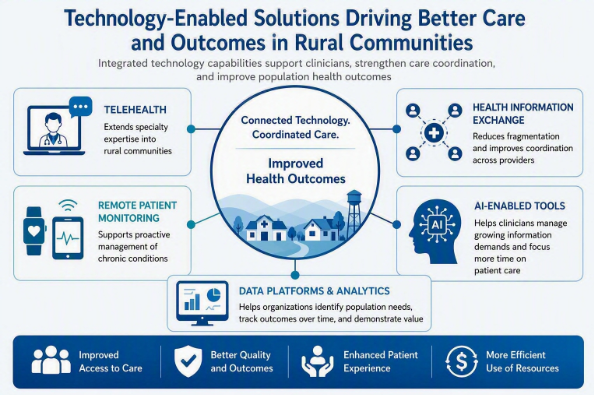
Throughout the AI preconference session and the main event, healthcare organizations grappled with the immediate challenge of deciding where AI adds value and whether they are prepared to use it responsibly.
The AI preconference discussion focused on a framework to support key decisions and the need to put readiness before adoption. Core components of the readiness framework include reliable data, workforce preparation, engaged leadership, governance, and clear operational processes. Both technology experts and clinical leaders encouraged organizations to prioritize practical, high-value use cases rather than implementing AI broadly for its own sake.
And, as the conference discussion of the Office of the National Coordinator’s Trusted Exchange Framework and Common Agreement (TEFCA) and the Centers for Medicare & Medicaid Services (CMS) Health Tech Ecosystem demonstrated, simply connecting more data is too little. The next step is making that information usable in ways that improve decisions, coordination, and care without creating additional work.
What leaders should be thinking about
Before making the next technology investment, organizations should be clear about the problems they are trying to solve. The strongest use cases will connect technology to a defined operational or clinical need, supported by the governance, data workforce, and measurement needed to determine whether is is actually working.
5. Some of the biggest opportunities are emerging between programs, sectors, and traditional lines of business
Healthcare may be organized around programs and sectors, but the problems leaders are trying to solve rarely respect those boundaries.
That was particularly evident in conversations about behavioral health. People with complex needs often interact with not only healthcare providers, but also housing, social services, and criminal justice systems. Better outcomes, therefore, depend in part on connecting services and organizations that historically have operated separately.
The same concept surfaced during the discussion about sustaining access. Speakers challenged organizations to move beyond a siloed mindset and focus more broadly on what patients and communities need while using partnerships to extend their reach.
A conversation with leaders from the US Department of Veterans Affairs (VA) offered another perspective on this opportunity. The VA is taking steps to make its healthcare data more actionable and to ensure its Community Care program draws on core capabilities of industry and to ensures its approach is informed by both Medicare and Medicaid.
There is an important strategic implication here. Expertise developed in Medicaid managed care, value-based purchasing, population health, provider networks, data analytics, program integrity, interoperability, and implementation does not necessarily have to remain within the business or program where it originated. Leaders have an opportunity to look across the healthcare ecosystem for proven approaches and consider where those capabilities can solve problems in new settings.
What healthcare leaders should be thinking about
The next opportunity may site outside the line of business in which an organization has traditionally operated. Leaders who can identify where their expertise translates, and where partners bring complementary capabilities, may find new ways to address longstanding challenges.
From Responding to Change to Shaping What Comes Next
The discussions at HMA’s 2026 National Conference point to a healthcare environment that is entering a different phase. Understanding policy change remains essential. The work ahead, however, needs to be strategic and transformational.
The leaders best positioned for what comes next will know where their organizations create value, be able to demonstrate it, and recognize when bringing that expertise into a new partnership, program, or market can be transformative.
HMA can help leaders move this work forward by bringing the right partners to the table and connecting strategy with execution. As a convener and strategic advisor, HMA combines market and policy expertise with data analysis and technology capabilities to help organizations assess changing expectations, align financial and operating models, and build partnerships that deliver measurable value.
These conversations continue in 2026 through HMA’s State of Reform events, where policymakers, health plans, providers, community organizations, and other stakeholders come together to examine state and local market realities and develop practical solutions. HMA’s next national conference will be held October 12-14, 2027, in Nashville, TN.